AC Freezing Up on a Hot Day? Why Ice Forms and What to Do
October 22, 2026
Quick Answer: An air conditioner freezes up when the indoor evaporator coil drops below 32 degrees and the moisture pulled out of your air turns to ice. The two most common triggers are restricted airflow, from a dirty filter, closed vents, or blocked returns, and low refrigerant from a slow leak. To thaw it, turn the cooling off, run only the fan, replace the filter, and give the ice several hours to melt on its own. If it freezes again after airflow is restored, the cause is almost always refrigerant or a failing part that needs a technician.
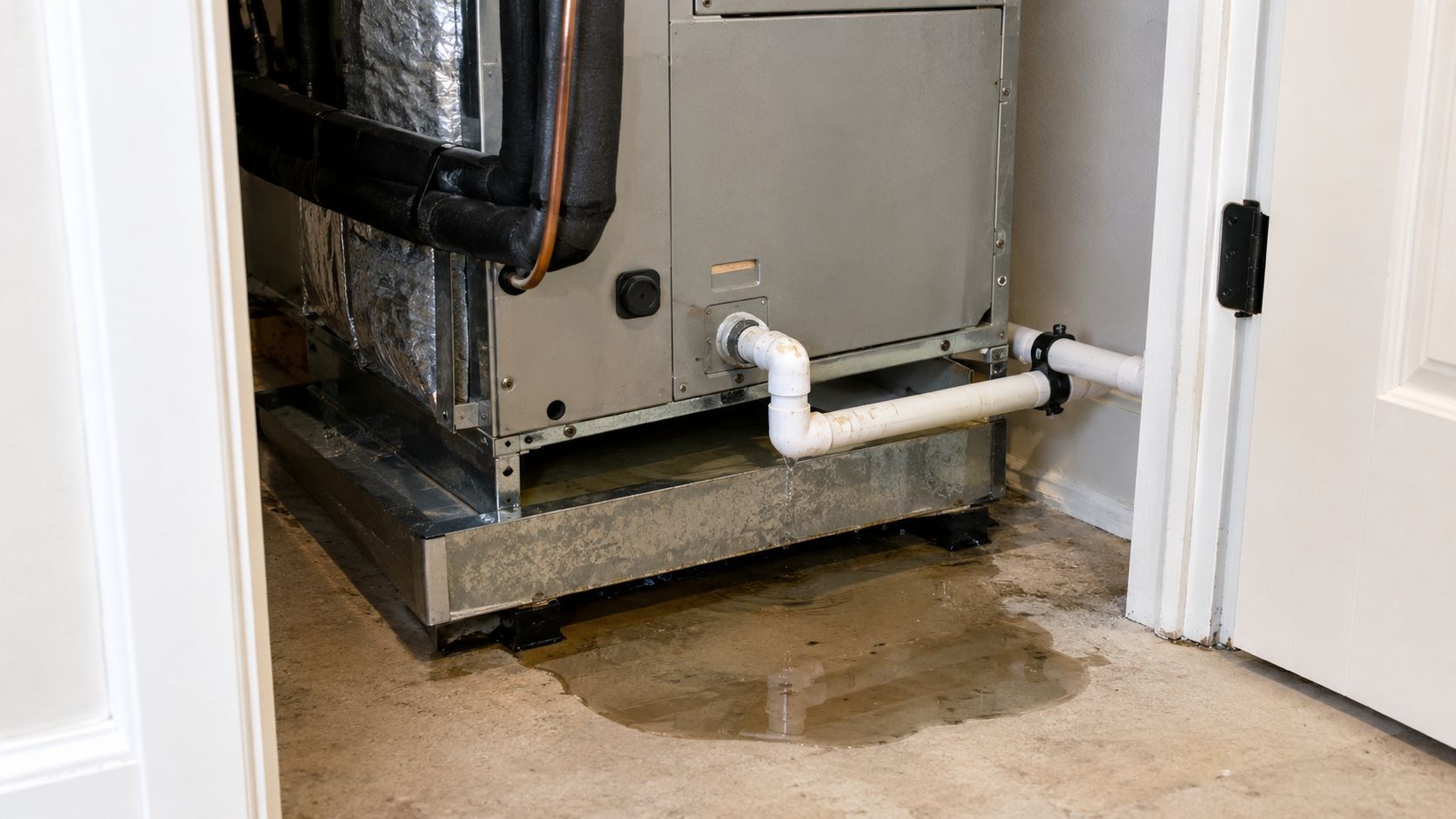
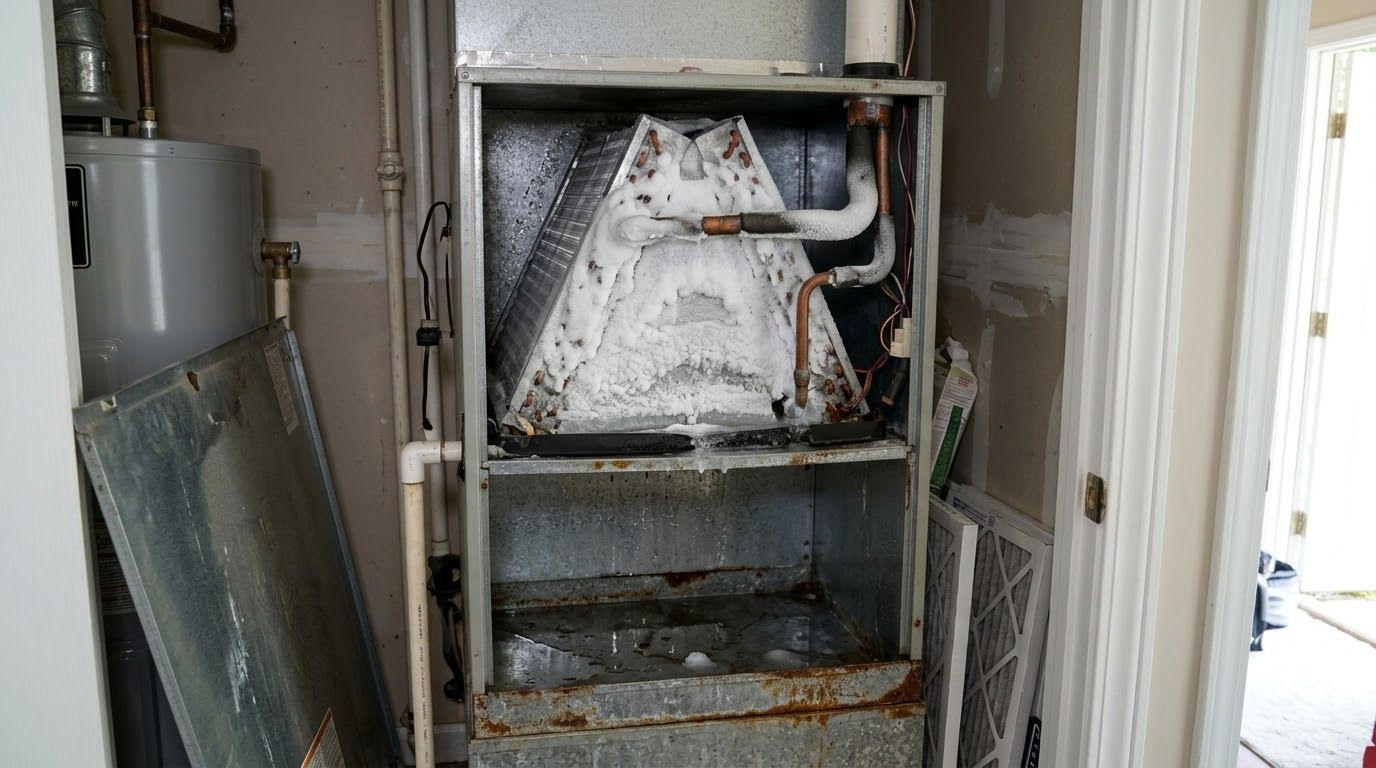
It is the middle of a July afternoon in Hall County, the thermometer on the porch says 96, and the house is getting warmer by the hour. The vents are blowing, but the air feels weak and lukewarm. You open the closet door and look at the indoor unit, and there it is: a crust of frost on the copper line, or a solid block of ice where the coil should be. Maybe there is a puddle on the floor underneath, too.
Ice on an air conditioner on the hottest day of the year looks like it should be impossible, which is exactly why it catches so many homeowners off guard. The system is not too cold in the way a freezer is cold. It is a heat transfer problem that went wrong, and once you understand the mechanism, the causes and the fix make a lot more sense.
Quick Answer: One room that's always hotter than the rest usually means that room isn't getting its fair share of cooled air, an airflow problem, not a broken air conditioner. Common causes are undersized, blocked, or leaky ductwork to that room, a closed or obstructed register, the room being farthest from the unit, poor insulation or lots of sun, or an unbalanced system. The fix is diagnosing why the air isn't reaching that room and correcting the airflow, not just turning the thermostat down for the whole house.
It is a common Georgia summer frustration: most of the house is comfortable, but one room, a back bedroom, an upstairs office, the room over the garage, is always warmer than everywhere else. You turn the thermostat down, and the rest of the house gets cold while that one room still runs hot. The AC seems to be working, so what is going on?
In almost every case, the answer is airflow. That hot room is not getting its fair share of the cooled air the system is producing, and no amount of lowering the thermostat fixes an air-delivery problem; it just overcools everywhere else. Uneven temperatures between rooms are one of the most common cooling complaints, and they usually trace back to how, and whether, conditioned air is reaching each room. Understanding why one room runs hot points to the actual fix. Here is what is behind that stubborn warm room.
Why Ventilation Plays a Critical Role
Ventilation serves as one of the most important components of indoor air quality management. Without adequate fresh air exchange, contaminants remain trapped indoors and continue accumulating.
Modern energy-efficient buildings often have tighter construction, reducing natural airflow and increasing the need for mechanical ventilation solutions.
Professional ventilation strategies help remove stale air while introducing fresh outdoor air under controlled conditions.
Energy Recovery and Fresh Air Systems
Specialized ventilation equipment can improve indoor air quality without significantly increasing energy consumption.
Common systems include:
Energy Recovery Ventilators (ERVs)
ERV systems exchange stale indoor air with fresh outdoor air while helping maintain indoor temperature and humidity balance.
Heat Recovery Ventilators (HRVs)
HRVs improve ventilation efficiency by transferring heat between outgoing and incoming air streams during colder months.
These systems help improve air quality while supporting overall HVAC efficiency.
Managing Indoor Humidity
Humidity plays a major role in indoor comfort and air quality. Excess moisture can encourage mold growth and create conditions favorable to dust mites. Low humidity can contribute to dry skin, respiratory irritation, and discomfort.
Professional humidity control solutions may include:
- Whole-home humidifiers
- Whole-home dehumidifiers
- Ventilation improvements
- HVAC adjustments
Maintaining balanced humidity levels helps support healthier indoor conditions throughout the year.
How Ice Forms Inside a Working Air Conditioner
Your indoor coil is supposed to be cold. Liquid refrigerant flows through it and absorbs heat from the air your blower pushes across the fins, and that is what cools your home. In a healthy system, the coil runs in the neighborhood of 40 degrees, which is cold enough to pull humidity out of the air as water droplets but still above freezing. Those droplets run down into the drain pan and out through the condensate line.
Ice forms when something upsets that balance. If the coil stops receiving enough warm air to absorb heat from, or if the refrigerant pressure inside it drops too low, the coil surface falls below 32 degrees. The water that would normally drip away freezes onto the fins instead. Once a thin layer of ice builds up, it insulates the coil and blocks even more airflow, which makes the coil colder, which grows the ice faster. A small problem snowballs into a block of ice in a few hours.
That is why a frozen coil is a symptom and not a diagnosis. The ice tells you the balance between airflow and refrigerant has broken somewhere. Finding where is the whole job.
Quick Answer: One room that's always hotter than the rest usually means that room isn't getting its fair share of cooled air, an airflow problem, not a broken air conditioner. Common causes are undersized, blocked, or leaky ductwork to that room, a closed or obstructed register, the room being farthest from the unit, poor insulation or lots of sun, or an unbalanced system. The fix is diagnosing why the air isn't reaching that room and correcting the airflow, not just turning the thermostat down for the whole house.
It is a common Georgia summer frustration: most of the house is comfortable, but one room, a back bedroom, an upstairs office, the room over the garage, is always warmer than everywhere else. You turn the thermostat down, and the rest of the house gets cold while that one room still runs hot. The AC seems to be working, so what is going on?
In almost every case, the answer is airflow. That hot room is not getting its fair share of the cooled air the system is producing, and no amount of lowering the thermostat fixes an air-delivery problem; it just overcools everywhere else. Uneven temperatures between rooms are one of the most common cooling complaints, and they usually trace back to how, and whether, conditioned air is reaching each room. Understanding why one room runs hot points to the actual fix. Here is what is behind that stubborn warm room.
Why Ventilation Plays a Critical Role
Ventilation serves as one of the most important components of indoor air quality management. Without adequate fresh air exchange, contaminants remain trapped indoors and continue accumulating.
Modern energy-efficient buildings often have tighter construction, reducing natural airflow and increasing the need for mechanical ventilation solutions.
Professional ventilation strategies help remove stale air while introducing fresh outdoor air under controlled conditions.
Energy Recovery and Fresh Air Systems
Specialized ventilation equipment can improve indoor air quality without significantly increasing energy consumption.
Common systems include:
Energy Recovery Ventilators (ERVs)
ERV systems exchange stale indoor air with fresh outdoor air while helping maintain indoor temperature and humidity balance.
Heat Recovery Ventilators (HRVs)
HRVs improve ventilation efficiency by transferring heat between outgoing and incoming air streams during colder months.
These systems help improve air quality while supporting overall HVAC efficiency.
Managing Indoor Humidity
Humidity plays a major role in indoor comfort and air quality. Excess moisture can encourage mold growth and create conditions favorable to dust mites. Low humidity can contribute to dry skin, respiratory irritation, and discomfort.
Professional humidity control solutions may include:
- Whole-home humidifiers
- Whole-home dehumidifiers
- Ventilation improvements
- HVAC adjustments
Maintaining balanced humidity levels helps support healthier indoor conditions throughout the year.
The Airflow Problems That Cause Most Freeze Ups
When a technician walks into a house with a frozen system, airflow is the first place to look, because it is the cause behind a large share of freeze ups and the easiest to check.
A Clogged Filter
North Georgia’s heavy spring pollen quickly loads air filters with debris. Restricted airflow prevents sufficient air from crossing the evaporator coil, causing it to become excessively cold.
Closed Or Blocked Vents
Closing unused room registers increases duct pressure and reduces airflow across the coil. Furniture, rugs, or curtains covering return grilles can also restrict circulation and contribute to freezing.
A Dirty Evaporator Coil
Dust bypassing the filter gradually coats evaporator coil fins, restricting airflow. Even with a clean filter, accumulated debris can prevent proper heat transfer and cause freezing.
A Weak Blower Or A Failing Motor
A worn capacitor, dirty blower wheel, or failing motor can reduce airflow while the system runs. Insufficient air circulation allows the evaporator coil to freeze.
Crushed Or Disconnected Ductwork
Collapsed or disconnected return ducts, particularly in hot attics, restrict airflow and starve the system. Older homes with damaged flexible ductwork commonly experience this problem during summer.
Tip: Pull your filter out and hold it up to a light. If you cannot see light through it, it is restricting airflow. During pollen season in North Georgia, checking it every few weeks is a better habit than waiting for the calendar reminder.
Quick Answer: One room that's always hotter than the rest usually means that room isn't getting its fair share of cooled air, an airflow problem, not a broken air conditioner. Common causes are undersized, blocked, or leaky ductwork to that room, a closed or obstructed register, the room being farthest from the unit, poor insulation or lots of sun, or an unbalanced system. The fix is diagnosing why the air isn't reaching that room and correcting the airflow, not just turning the thermostat down for the whole house.
It is a common Georgia summer frustration: most of the house is comfortable, but one room, a back bedroom, an upstairs office, the room over the garage, is always warmer than everywhere else. You turn the thermostat down, and the rest of the house gets cold while that one room still runs hot. The AC seems to be working, so what is going on?
In almost every case, the answer is airflow. That hot room is not getting its fair share of the cooled air the system is producing, and no amount of lowering the thermostat fixes an air-delivery problem; it just overcools everywhere else. Uneven temperatures between rooms are one of the most common cooling complaints, and they usually trace back to how, and whether, conditioned air is reaching each room. Understanding why one room runs hot points to the actual fix. Here is what is behind that stubborn warm room.
Why Ventilation Plays a Critical Role
Ventilation serves as one of the most important components of indoor air quality management. Without adequate fresh air exchange, contaminants remain trapped indoors and continue accumulating.
Modern energy-efficient buildings often have tighter construction, reducing natural airflow and increasing the need for mechanical ventilation solutions.
Professional ventilation strategies help remove stale air while introducing fresh outdoor air under controlled conditions.
Energy Recovery and Fresh Air Systems
Specialized ventilation equipment can improve indoor air quality without significantly increasing energy consumption.
Common systems include:
Energy Recovery Ventilators (ERVs)
ERV systems exchange stale indoor air with fresh outdoor air while helping maintain indoor temperature and humidity balance.
Heat Recovery Ventilators (HRVs)
HRVs improve ventilation efficiency by transferring heat between outgoing and incoming air streams during colder months.
These systems help improve air quality while supporting overall HVAC efficiency.
Managing Indoor Humidity
Humidity plays a major role in indoor comfort and air quality. Excess moisture can encourage mold growth and create conditions favorable to dust mites. Low humidity can contribute to dry skin, respiratory irritation, and discomfort.
Professional humidity control solutions may include:
- Whole-home humidifiers
- Whole-home dehumidifiers
- Ventilation improvements
- HVAC adjustments
Maintaining balanced humidity levels helps support healthier indoor conditions throughout the year.
When Low Refrigerant Is the Real Culprit
Refrigerant is not used up like gasoline. A properly sealed system holds the same charge for its whole life. So when a coil freezes because the refrigerant is low, it means there is a leak somewhere, and topping off without finding it only buys time.
Here is what happens inside the system. With less refrigerant circulating, the pressure in the coil drops. Lower pressure means a lower boiling temperature for the refrigerant, and the coil surface gets colder than the design range. It dips below freezing even though plenty of warm air is moving across it. Ice usually shows up first on the copper line leading to the outdoor unit and on the coil's lowest fins, and it works its way back from there.
A few clues point toward refrigerant instead of airflow. The filter is clean and every vent is open, yet the system still freezes. The cooling has been getting weaker over several weeks before the ice appeared. You may hear a faint hiss or bubbling near the indoor unit. The system freezes again within a day or two of being thawed.
Refrigerant work requires an EPA certified technician, so this is not a place for a do it yourself fix. The right repair is to locate the leak, fix it, and then restore the charge to the manufacturer's specification, not to a guess.
Quick Answer: One room that's always hotter than the rest usually means that room isn't getting its fair share of cooled air, an airflow problem, not a broken air conditioner. Common causes are undersized, blocked, or leaky ductwork to that room, a closed or obstructed register, the room being farthest from the unit, poor insulation or lots of sun, or an unbalanced system. The fix is diagnosing why the air isn't reaching that room and correcting the airflow, not just turning the thermostat down for the whole house.
It is a common Georgia summer frustration: most of the house is comfortable, but one room, a back bedroom, an upstairs office, the room over the garage, is always warmer than everywhere else. You turn the thermostat down, and the rest of the house gets cold while that one room still runs hot. The AC seems to be working, so what is going on?
In almost every case, the answer is airflow. That hot room is not getting its fair share of the cooled air the system is producing, and no amount of lowering the thermostat fixes an air-delivery problem; it just overcools everywhere else. Uneven temperatures between rooms are one of the most common cooling complaints, and they usually trace back to how, and whether, conditioned air is reaching each room. Understanding why one room runs hot points to the actual fix. Here is what is behind that stubborn warm room.
Why Ventilation Plays a Critical Role
Ventilation serves as one of the most important components of indoor air quality management. Without adequate fresh air exchange, contaminants remain trapped indoors and continue accumulating.
Modern energy-efficient buildings often have tighter construction, reducing natural airflow and increasing the need for mechanical ventilation solutions.
Professional ventilation strategies help remove stale air while introducing fresh outdoor air under controlled conditions.
Energy Recovery and Fresh Air Systems
Specialized ventilation equipment can improve indoor air quality without significantly increasing energy consumption.
Common systems include:
Energy Recovery Ventilators (ERVs)
ERV systems exchange stale indoor air with fresh outdoor air while helping maintain indoor temperature and humidity balance.
Heat Recovery Ventilators (HRVs)
HRVs improve ventilation efficiency by transferring heat between outgoing and incoming air streams during colder months.
These systems help improve air quality while supporting overall HVAC efficiency.
Managing Indoor Humidity
Humidity plays a major role in indoor comfort and air quality. Excess moisture can encourage mold growth and create conditions favorable to dust mites. Low humidity can contribute to dry skin, respiratory irritation, and discomfort.
Professional humidity control solutions may include:
- Whole-home humidifiers
- Whole-home dehumidifiers
- Ventilation improvements
- HVAC adjustments
Maintaining balanced humidity levels helps support healthier indoor conditions throughout the year.
Georgia Humidity and the Freeze Up Connection
Our climate adds a wrinkle that cooler regions do not deal with. In a North Georgia summer, outdoor dew points sit in the seventies for weeks, and your system is constantly pulling large volumes of moisture out of the air. That means the coil is wet all the time. Water on a coil is what turns into ice the moment the surface drops below freezing, so a marginal airflow problem that might only cause weak cooling in a dry climate can freeze the coil solid here.
The reverse happens in the shoulder seasons. On a mild spring or fall night in Gainesville or Dahlonega, the temperature can fall into the fifties while someone leaves the AC running. Cooling at low outdoor temperatures can let the coil dip below freezing even with decent airflow, because the system has very little heat load to work against. If you do not need cooling overnight in April or October, it is better to let the house ride.
Heat pump owners should also know that a thin layer of frost on the outdoor unit in winter can be a normal part of the defrost cycle. Ice on the indoor coil during cooling season is a different matter, and it is never normal.
Quick Answer: One room that's always hotter than the rest usually means that room isn't getting its fair share of cooled air, an airflow problem, not a broken air conditioner. Common causes are undersized, blocked, or leaky ductwork to that room, a closed or obstructed register, the room being farthest from the unit, poor insulation or lots of sun, or an unbalanced system. The fix is diagnosing why the air isn't reaching that room and correcting the airflow, not just turning the thermostat down for the whole house.
It is a common Georgia summer frustration: most of the house is comfortable, but one room, a back bedroom, an upstairs office, the room over the garage, is always warmer than everywhere else. You turn the thermostat down, and the rest of the house gets cold while that one room still runs hot. The AC seems to be working, so what is going on?
In almost every case, the answer is airflow. That hot room is not getting its fair share of the cooled air the system is producing, and no amount of lowering the thermostat fixes an air-delivery problem; it just overcools everywhere else. Uneven temperatures between rooms are one of the most common cooling complaints, and they usually trace back to how, and whether, conditioned air is reaching each room. Understanding why one room runs hot points to the actual fix. Here is what is behind that stubborn warm room.
Why Ventilation Plays a Critical Role
Ventilation serves as one of the most important components of indoor air quality management. Without adequate fresh air exchange, contaminants remain trapped indoors and continue accumulating.
Modern energy-efficient buildings often have tighter construction, reducing natural airflow and increasing the need for mechanical ventilation solutions.
Professional ventilation strategies help remove stale air while introducing fresh outdoor air under controlled conditions.
Energy Recovery and Fresh Air Systems
Specialized ventilation equipment can improve indoor air quality without significantly increasing energy consumption.
Common systems include:
Energy Recovery Ventilators (ERVs)
ERV systems exchange stale indoor air with fresh outdoor air while helping maintain indoor temperature and humidity balance.
Heat Recovery Ventilators (HRVs)
HRVs improve ventilation efficiency by transferring heat between outgoing and incoming air streams during colder months.
These systems help improve air quality while supporting overall HVAC efficiency.
Managing Indoor Humidity
Humidity plays a major role in indoor comfort and air quality. Excess moisture can encourage mold growth and create conditions favorable to dust mites. Low humidity can contribute to dry skin, respiratory irritation, and discomfort.
Professional humidity control solutions may include:
- Whole-home humidifiers
- Whole-home dehumidifiers
- Ventilation improvements
- HVAC adjustments
Maintaining balanced humidity levels helps support healthier indoor conditions throughout the year.
How to Thaw a Frozen AC Safely
If you find ice, the first move is to stop making it worse. Here is the order that works.
- Switch the thermostat from Cool to Off. Running the compressor against a frozen coil can damage it.
- Set the fan to On. Moving house air across the coil speeds up thawing without adding cold.
- Replace or clean the filter, and open every supply and return register.
- Wait. A light frost may clear in an hour or two, and heavy ice can take four hours or overnight. Put towels or a shallow pan under the unit, because melting ice will produce more water than the drain pan expects.
- When the coil is fully clear and no water is dripping, switch back to Cool and watch the system for the next day.
Warning: Never chip at the ice with a screwdriver or knife, and never aim a hair dryer or space heater at the coil. The fins and refrigerant lines are thin and easily punctured, and a punctured coil means a replacement part instead of a simple thaw.
If the system froze once because of a dirty filter and stays clear after you fix it, you probably solved it. If the ice returns within a few days, stop cycling it on and off. Repeated freezing and thawing stresses the compressor, and the cause is something a filter change will not fix.
Quick Answer: One room that's always hotter than the rest usually means that room isn't getting its fair share of cooled air, an airflow problem, not a broken air conditioner. Common causes are undersized, blocked, or leaky ductwork to that room, a closed or obstructed register, the room being farthest from the unit, poor insulation or lots of sun, or an unbalanced system. The fix is diagnosing why the air isn't reaching that room and correcting the airflow, not just turning the thermostat down for the whole house.
It is a common Georgia summer frustration: most of the house is comfortable, but one room, a back bedroom, an upstairs office, the room over the garage, is always warmer than everywhere else. You turn the thermostat down, and the rest of the house gets cold while that one room still runs hot. The AC seems to be working, so what is going on?
In almost every case, the answer is airflow. That hot room is not getting its fair share of the cooled air the system is producing, and no amount of lowering the thermostat fixes an air-delivery problem; it just overcools everywhere else. Uneven temperatures between rooms are one of the most common cooling complaints, and they usually trace back to how, and whether, conditioned air is reaching each room. Understanding why one room runs hot points to the actual fix. Here is what is behind that stubborn warm room.
Why Ventilation Plays a Critical Role
Ventilation serves as one of the most important components of indoor air quality management. Without adequate fresh air exchange, contaminants remain trapped indoors and continue accumulating.
Modern energy-efficient buildings often have tighter construction, reducing natural airflow and increasing the need for mechanical ventilation solutions.
Professional ventilation strategies help remove stale air while introducing fresh outdoor air under controlled conditions.
Energy Recovery and Fresh Air Systems
Specialized ventilation equipment can improve indoor air quality without significantly increasing energy consumption.
Common systems include:
Energy Recovery Ventilators (ERVs)
ERV systems exchange stale indoor air with fresh outdoor air while helping maintain indoor temperature and humidity balance.
Heat Recovery Ventilators (HRVs)
HRVs improve ventilation efficiency by transferring heat between outgoing and incoming air streams during colder months.
These systems help improve air quality while supporting overall HVAC efficiency.
Managing Indoor Humidity
Humidity plays a major role in indoor comfort and air quality. Excess moisture can encourage mold growth and create conditions favorable to dust mites. Low humidity can contribute to dry skin, respiratory irritation, and discomfort.
Professional humidity control solutions may include:
- Whole-home humidifiers
- Whole-home dehumidifiers
- Ventilation improvements
- HVAC adjustments
Maintaining balanced humidity levels helps support healthier indoor conditions throughout the year.
What a Technician Checks During a Freeze Up Visit
A proper diagnosis follows the same logic as the mechanism. A technician will confirm the coil is fully thawed so readings are accurate, then work through the system in sequence.
They start with airflow: filter condition, blower speed, static pressure across the duct system, and the condition of the coil itself. Then they check the temperature drop across the coil and measure refrigerant pressures to see whether the charge matches what the system should hold. If pressures are low, a leak search follows, using electronic detection or a pressure test. They also look at the condensate drain, since a backed up drain pan can hold water against the coil, and at the thermostat and blower controls to rule out a setting or sensor that is telling the system to run wrong.
The goal is one specific answer, such as a clogged coil that needs cleaning, a failing blower capacitor, a leak at a particular joint, or a return duct that has come apart. Guessing and adding refrigerant skips that step and usually leads to a second service call.
Quick Answer: One room that's always hotter than the rest usually means that room isn't getting its fair share of cooled air, an airflow problem, not a broken air conditioner. Common causes are undersized, blocked, or leaky ductwork to that room, a closed or obstructed register, the room being farthest from the unit, poor insulation or lots of sun, or an unbalanced system. The fix is diagnosing why the air isn't reaching that room and correcting the airflow, not just turning the thermostat down for the whole house.
It is a common Georgia summer frustration: most of the house is comfortable, but one room, a back bedroom, an upstairs office, the room over the garage, is always warmer than everywhere else. You turn the thermostat down, and the rest of the house gets cold while that one room still runs hot. The AC seems to be working, so what is going on?
In almost every case, the answer is airflow. That hot room is not getting its fair share of the cooled air the system is producing, and no amount of lowering the thermostat fixes an air-delivery problem; it just overcools everywhere else. Uneven temperatures between rooms are one of the most common cooling complaints, and they usually trace back to how, and whether, conditioned air is reaching each room. Understanding why one room runs hot points to the actual fix. Here is what is behind that stubborn warm room.
Why Ventilation Plays a Critical Role
Ventilation serves as one of the most important components of indoor air quality management. Without adequate fresh air exchange, contaminants remain trapped indoors and continue accumulating.
Modern energy-efficient buildings often have tighter construction, reducing natural airflow and increasing the need for mechanical ventilation solutions.
Professional ventilation strategies help remove stale air while introducing fresh outdoor air under controlled conditions.
Energy Recovery and Fresh Air Systems
Specialized ventilation equipment can improve indoor air quality without significantly increasing energy consumption.
Common systems include:
Energy Recovery Ventilators (ERVs)
ERV systems exchange stale indoor air with fresh outdoor air while helping maintain indoor temperature and humidity balance.
Heat Recovery Ventilators (HRVs)
HRVs improve ventilation efficiency by transferring heat between outgoing and incoming air streams during colder months.
These systems help improve air quality while supporting overall HVAC efficiency.
Managing Indoor Humidity
Humidity plays a major role in indoor comfort and air quality. Excess moisture can encourage mold growth and create conditions favorable to dust mites. Low humidity can contribute to dry skin, respiratory irritation, and discomfort.
Professional humidity control solutions may include:
- Whole-home humidifiers
- Whole-home dehumidifiers
- Ventilation improvements
- HVAC adjustments
Maintaining balanced humidity levels helps support healthier indoor conditions throughout the year.
Preventing the Next Freeze Up
Most freeze ups are preventable with a few habits suited to our climate. Change the filter on a schedule that matches pollen season and household dust, not just the calendar. Keep supply and return vents open and unblocked. Make sure the area around the outdoor unit is clear of leaves, grass clippings, and pollen drifts so the system can shed heat. Have the indoor coil, blower, and drain line inspected and cleaned during a spring tune up before the heavy cooling season begins, since that is when small problems are cheapest to catch and least inconvenient to fix.
Quick Answer: One room that's always hotter than the rest usually means that room isn't getting its fair share of cooled air, an airflow problem, not a broken air conditioner. Common causes are undersized, blocked, or leaky ductwork to that room, a closed or obstructed register, the room being farthest from the unit, poor insulation or lots of sun, or an unbalanced system. The fix is diagnosing why the air isn't reaching that room and correcting the airflow, not just turning the thermostat down for the whole house.
It is a common Georgia summer frustration: most of the house is comfortable, but one room, a back bedroom, an upstairs office, the room over the garage, is always warmer than everywhere else. You turn the thermostat down, and the rest of the house gets cold while that one room still runs hot. The AC seems to be working, so what is going on?
In almost every case, the answer is airflow. That hot room is not getting its fair share of the cooled air the system is producing, and no amount of lowering the thermostat fixes an air-delivery problem; it just overcools everywhere else. Uneven temperatures between rooms are one of the most common cooling complaints, and they usually trace back to how, and whether, conditioned air is reaching each room. Understanding why one room runs hot points to the actual fix. Here is what is behind that stubborn warm room.
Frequently Asked Questions
Why is my AC freezing up when it is so hot outside?
Outdoor temperature does not control it. What matters is the balance between airflow and refrigerant pressure. If either drops, the coil falls below freezing even at 95 degrees, and humidity feeds the ice.
How long does it take a frozen AC to thaw?
A light layer of frost may melt in one to two hours with the system off and the fan running. A heavy block can take four hours or longer. Wait until fully clear.
Can I keep running my AC if it is frozen?
No. A frozen coil cannot cool properly, and running the compressor against it can send liquid refrigerant back to the compressor, one of the most damaging failures. Run only the fan until clear.
Does a frozen coil mean I need more refrigerant?
Not always. Restricted airflow is a very common cause, and adding refrigerant to an airflow problem makes things worse. When refrigerant is truly low, a leak exists and needs repair, not repeated topping off.
Will a dirty filter alone freeze my AC?
Yes, it can. A badly clogged filter cuts the air moving across the coil enough to push its surface below freezing, especially in humid weather. If it stays clear afterward, that was the cause.
What should I do if my AC keeps freezing up after I thaw it?
Leave it off and schedule a diagnostic visit. A repeat freeze after a clean filter and open vents points toward low refrigerant, a dirty coil, a weak blower, or a duct problem.
Quick Answer: One room that's always hotter than the rest usually means that room isn't getting its fair share of cooled air, an airflow problem, not a broken air conditioner. Common causes are undersized, blocked, or leaky ductwork to that room, a closed or obstructed register, the room being farthest from the unit, poor insulation or lots of sun, or an unbalanced system. The fix is diagnosing why the air isn't reaching that room and correcting the airflow, not just turning the thermostat down for the whole house.
It is a common Georgia summer frustration: most of the house is comfortable, but one room, a back bedroom, an upstairs office, the room over the garage, is always warmer than everywhere else. You turn the thermostat down, and the rest of the house gets cold while that one room still runs hot. The AC seems to be working, so what is going on?
In almost every case, the answer is airflow. That hot room is not getting its fair share of the cooled air the system is producing, and no amount of lowering the thermostat fixes an air-delivery problem; it just overcools everywhere else. Uneven temperatures between rooms are one of the most common cooling complaints, and they usually trace back to how, and whether, conditioned air is reaching each room. Understanding why one room runs hot points to the actual fix. Here is what is behind that stubborn warm room.
Why Ventilation Plays a Critical Role
Ventilation serves as one of the most important components of indoor air quality management. Without adequate fresh air exchange, contaminants remain trapped indoors and continue accumulating.
Modern energy-efficient buildings often have tighter construction, reducing natural airflow and increasing the need for mechanical ventilation solutions.
Professional ventilation strategies help remove stale air while introducing fresh outdoor air under controlled conditions.
Energy Recovery and Fresh Air Systems
Specialized ventilation equipment can improve indoor air quality without significantly increasing energy consumption.
Common systems include:
Energy Recovery Ventilators (ERVs)
ERV systems exchange stale indoor air with fresh outdoor air while helping maintain indoor temperature and humidity balance.
Heat Recovery Ventilators (HRVs)
HRVs improve ventilation efficiency by transferring heat between outgoing and incoming air streams during colder months.
These systems help improve air quality while supporting overall HVAC efficiency.
Managing Indoor Humidity
Humidity plays a major role in indoor comfort and air quality. Excess moisture can encourage mold growth and create conditions favorable to dust mites. Low humidity can contribute to dry skin, respiratory irritation, and discomfort.
Professional humidity control solutions may include:
- Whole-home humidifiers
- Whole-home dehumidifiers
- Ventilation improvements
- HVAC adjustments
Maintaining balanced humidity levels helps support healthier indoor conditions throughout the year.
A Frozen Coil Is A Clear Message
Ice on an air conditioner feels like a breakdown, but it is really a clear message that airflow or refrigerant has drifted out of balance. The system is not too cold the way a freezer is cold. It is a heat transfer problem that tipped the coil below freezing, and the ice itself only tells you the balance broke, not where. Catching it early, thawing it correctly, and finding the true cause protects the compressor, the costliest part of the system.
Georgia Air Control, LLC
has spent 15
years tracing frozen coils across Gainesville, GA, where heavy spring pollen and weeks of high humidity push marginal systems over the edge into ice. Working through the airflow first, then the refrigerant, is what separates a quick filter fix from a leak that needs a proper repair. The homeowners who have the least trouble are the ones who treat the first weak airflow or bit of frost as a reason to act rather than something to wait out.