
Water Pooling Around the Indoor Unit? Why the Condensate Line Clogs in Georgia Humidity
September 30, 2026
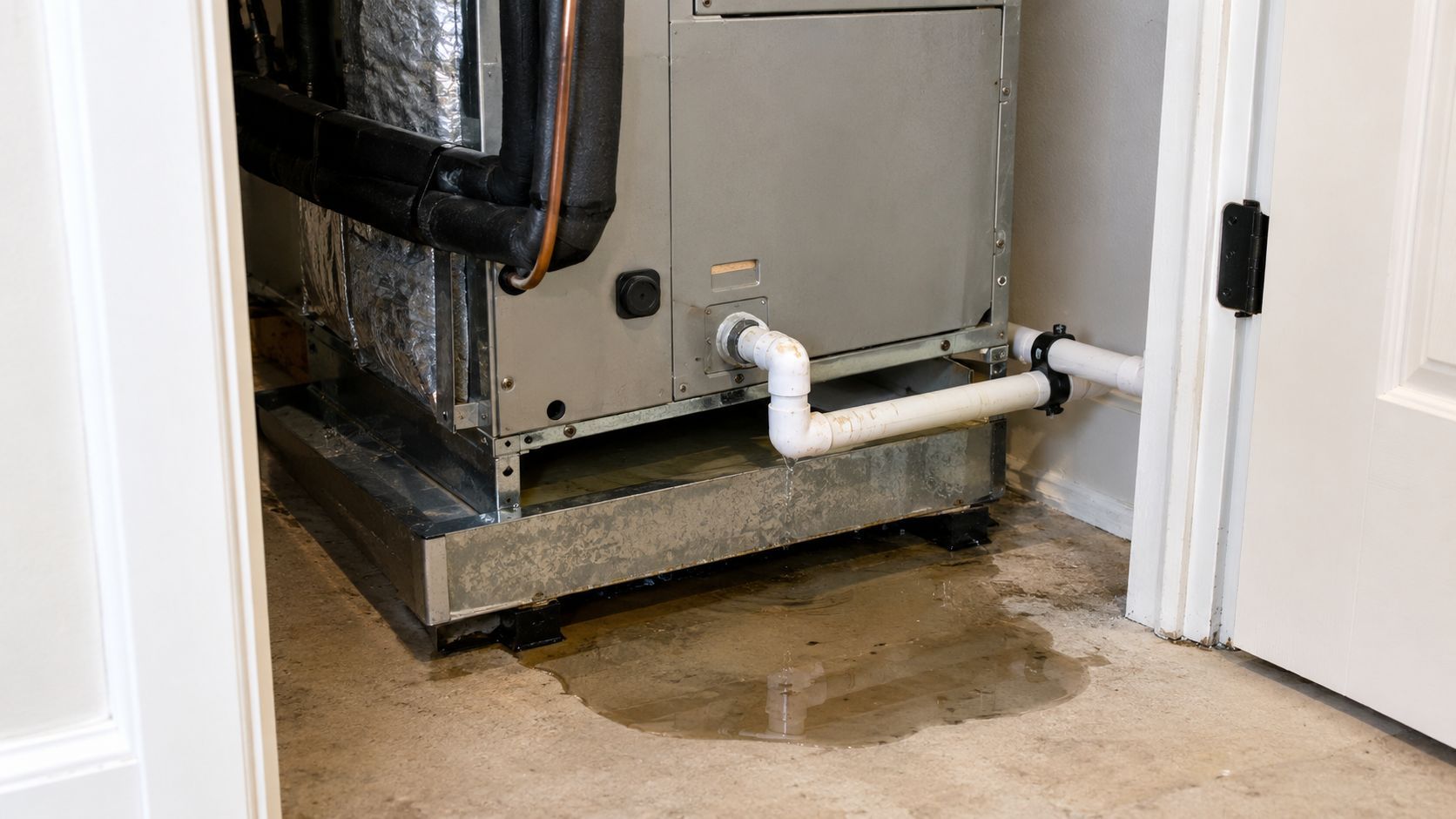
Quick Answer: Water pooling near your indoor air handler is almost always caused by a clogged condensate drain line, not a refrigerant leak. The reason: algae, dust, and biological sludge build up inside the line over time, and North Georgia's heat and humidity speed up that growth because the system runs longer and produces more moisture to drain. Once the line backs up, water fills the drain pan and either overflows onto the floor, soaks into the ceiling below an attic unit, or trips a safety float switch that shuts the whole system down. A technician clears the blockage with a wet/dry vacuum or line-clearing tool, checks the pan and float switch, and confirms the drain still has proper pitch before restarting the system.
You open the closet door and step in a puddle you swear wasn't there yesterday. Or maybe it's a water stain spreading across a ceiling tile below the attic, right under where the air handler sits. The AC is still blowing cold air. Nothing about the cooling itself seems off, which is what makes the puddle more confusing than alarming at first. It's a common call for HVAC crews working through a Georgia summer, and it almost never means the unit is failing. It means water that's supposed to leave the house through a small plastic pipe is finding another way out instead.
Every central air conditioner removes moisture from the air as a byproduct of cooling it, and that moisture has to go somewhere. On a normal summer day, that's a quiet, invisible process. When the drain line that carries it away gets blocked, the water backs up until it finds the path of least resistance — and in most homes, that path runs straight through a ceiling or across a closet floor.
Quick Answer: One room that's always hotter than the rest usually means that room isn't getting its fair share of cooled air, an airflow problem, not a broken air conditioner. Common causes are undersized, blocked, or leaky ductwork to that room, a closed or obstructed register, the room being farthest from the unit, poor insulation or lots of sun, or an unbalanced system. The fix is diagnosing why the air isn't reaching that room and correcting the airflow, not just turning the thermostat down for the whole house.
It is a common Georgia summer frustration: most of the house is comfortable, but one room, a back bedroom, an upstairs office, the room over the garage, is always warmer than everywhere else. You turn the thermostat down, and the rest of the house gets cold while that one room still runs hot. The AC seems to be working, so what is going on?
In almost every case, the answer is airflow. That hot room is not getting its fair share of the cooled air the system is producing, and no amount of lowering the thermostat fixes an air-delivery problem; it just overcools everywhere else. Uneven temperatures between rooms are one of the most common cooling complaints, and they usually trace back to how, and whether, conditioned air is reaching each room. Understanding why one room runs hot points to the actual fix. Here is what is behind that stubborn warm room.
Why Ventilation Plays a Critical Role
Ventilation serves as one of the most important components of indoor air quality management. Without adequate fresh air exchange, contaminants remain trapped indoors and continue accumulating.
Modern energy-efficient buildings often have tighter construction, reducing natural airflow and increasing the need for mechanical ventilation solutions.
Professional ventilation strategies help remove stale air while introducing fresh outdoor air under controlled conditions.
Energy Recovery and Fresh Air Systems
Specialized ventilation equipment can improve indoor air quality without significantly increasing energy consumption.
Common systems include:
Energy Recovery Ventilators (ERVs)
ERV systems exchange stale indoor air with fresh outdoor air while helping maintain indoor temperature and humidity balance.
Heat Recovery Ventilators (HRVs)
HRVs improve ventilation efficiency by transferring heat between outgoing and incoming air streams during colder months.
These systems help improve air quality while supporting overall HVAC efficiency.
Managing Indoor Humidity
Humidity plays a major role in indoor comfort and air quality. Excess moisture can encourage mold growth and create conditions favorable to dust mites. Low humidity can contribute to dry skin, respiratory irritation, and discomfort.
Professional humidity control solutions may include:
- Whole-home humidifiers
- Whole-home dehumidifiers
- Ventilation improvements
- HVAC adjustments
Maintaining balanced humidity levels helps support healthier indoor conditions throughout the year.
Where That Water Is Actually Coming From
The indoor half of your AC system, the evaporator coil, gets cold enough that humidity in the air condenses on it the same way moisture beads up on a glass of iced tea. That condensation drips into a drain pan underneath the coil, then flows out through a PVC condensate line to a drain, a floor sink, or an exterior discharge point. On a hot, humid day, a single residential system can produce a meaningful amount of water this way — enough that a clogged line becomes obvious within hours, not days, once it happens.
This is a feature of the system working correctly, not a malfunction. The AC is supposed to pull moisture out of your indoor air; that's part of what makes a house feel comfortable at a given temperature. The problem isn't that the system is producing condensate. The problem is that the line meant to carry it away has stopped doing its job.
Quick Answer: One room that's always hotter than the rest usually means that room isn't getting its fair share of cooled air, an airflow problem, not a broken air conditioner. Common causes are undersized, blocked, or leaky ductwork to that room, a closed or obstructed register, the room being farthest from the unit, poor insulation or lots of sun, or an unbalanced system. The fix is diagnosing why the air isn't reaching that room and correcting the airflow, not just turning the thermostat down for the whole house.
It is a common Georgia summer frustration: most of the house is comfortable, but one room, a back bedroom, an upstairs office, the room over the garage, is always warmer than everywhere else. You turn the thermostat down, and the rest of the house gets cold while that one room still runs hot. The AC seems to be working, so what is going on?
In almost every case, the answer is airflow. That hot room is not getting its fair share of the cooled air the system is producing, and no amount of lowering the thermostat fixes an air-delivery problem; it just overcools everywhere else. Uneven temperatures between rooms are one of the most common cooling complaints, and they usually trace back to how, and whether, conditioned air is reaching each room. Understanding why one room runs hot points to the actual fix. Here is what is behind that stubborn warm room.
Why Ventilation Plays a Critical Role
Ventilation serves as one of the most important components of indoor air quality management. Without adequate fresh air exchange, contaminants remain trapped indoors and continue accumulating.
Modern energy-efficient buildings often have tighter construction, reducing natural airflow and increasing the need for mechanical ventilation solutions.
Professional ventilation strategies help remove stale air while introducing fresh outdoor air under controlled conditions.
Energy Recovery and Fresh Air Systems
Specialized ventilation equipment can improve indoor air quality without significantly increasing energy consumption.
Common systems include:
Energy Recovery Ventilators (ERVs)
ERV systems exchange stale indoor air with fresh outdoor air while helping maintain indoor temperature and humidity balance.
Heat Recovery Ventilators (HRVs)
HRVs improve ventilation efficiency by transferring heat between outgoing and incoming air streams during colder months.
These systems help improve air quality while supporting overall HVAC efficiency.
Managing Indoor Humidity
Humidity plays a major role in indoor comfort and air quality. Excess moisture can encourage mold growth and create conditions favorable to dust mites. Low humidity can contribute to dry skin, respiratory irritation, and discomfort.
Professional humidity control solutions may include:
- Whole-home humidifiers
- Whole-home dehumidifiers
- Ventilation improvements
- HVAC adjustments
Maintaining balanced humidity levels helps support healthier indoor conditions throughout the year.
Why the Line Clogs Faster in North Georgia's Humidity
A condensate line is dark, damp, and rarely disturbed — close to ideal conditions for algae and biological sludge to take hold. Dust, pollen, and airborne debris get pulled into the drain pan along with the condensate, and over weeks that material combines with moisture sitting in the line to form a slick coating along the inside of the pipe. Once that coating builds up enough, it narrows the passage until water can no longer drain fast enough to keep up.
Longer Run Times Mean More Water and More Buildup
North Georgia’s hot, humid summers keep AC systems running longer, producing more condensate each day. More water moving through coated lines can make clogs develop faster than in drier climates.
Attic Installations Add a Layer of Risk Most Homeowners Don’t Think About
Many Gainesville, Buford, and surrounding-area homes have attic air handlers, where summer temperatures exceed 120 degrees. A clogged drain can quickly overflow, sending water through ceilings before homeowners notice.
Tip: Pour a cup of white vinegar down the condensate line's access point every few months during cooling season. It won't dissolve an existing hard clog, but it slows the biological buildup that causes most clogs in the first place, and it's a five-minute habit compared to a service call for water damage.
Quick Answer: One room that's always hotter than the rest usually means that room isn't getting its fair share of cooled air, an airflow problem, not a broken air conditioner. Common causes are undersized, blocked, or leaky ductwork to that room, a closed or obstructed register, the room being farthest from the unit, poor insulation or lots of sun, or an unbalanced system. The fix is diagnosing why the air isn't reaching that room and correcting the airflow, not just turning the thermostat down for the whole house.
It is a common Georgia summer frustration: most of the house is comfortable, but one room, a back bedroom, an upstairs office, the room over the garage, is always warmer than everywhere else. You turn the thermostat down, and the rest of the house gets cold while that one room still runs hot. The AC seems to be working, so what is going on?
In almost every case, the answer is airflow. That hot room is not getting its fair share of the cooled air the system is producing, and no amount of lowering the thermostat fixes an air-delivery problem; it just overcools everywhere else. Uneven temperatures between rooms are one of the most common cooling complaints, and they usually trace back to how, and whether, conditioned air is reaching each room. Understanding why one room runs hot points to the actual fix. Here is what is behind that stubborn warm room.
Why Ventilation Plays a Critical Role
Ventilation serves as one of the most important components of indoor air quality management. Without adequate fresh air exchange, contaminants remain trapped indoors and continue accumulating.
Modern energy-efficient buildings often have tighter construction, reducing natural airflow and increasing the need for mechanical ventilation solutions.
Professional ventilation strategies help remove stale air while introducing fresh outdoor air under controlled conditions.
Energy Recovery and Fresh Air Systems
Specialized ventilation equipment can improve indoor air quality without significantly increasing energy consumption.
Common systems include:
Energy Recovery Ventilators (ERVs)
ERV systems exchange stale indoor air with fresh outdoor air while helping maintain indoor temperature and humidity balance.
Heat Recovery Ventilators (HRVs)
HRVs improve ventilation efficiency by transferring heat between outgoing and incoming air streams during colder months.
These systems help improve air quality while supporting overall HVAC efficiency.
Managing Indoor Humidity
Humidity plays a major role in indoor comfort and air quality. Excess moisture can encourage mold growth and create conditions favorable to dust mites. Low humidity can contribute to dry skin, respiratory irritation, and discomfort.
Professional humidity control solutions may include:
- Whole-home humidifiers
- Whole-home dehumidifiers
- Ventilation improvements
- HVAC adjustments
Maintaining balanced humidity levels helps support healthier indoor conditions throughout the year.
What Happens Once the Line Backs Up
A blocked drain line doesn't just sit there quietly. Water has to go somewhere, and depending on how your system is set up, that means one of a few outcomes.
The Primary Drain Pan Overflows
Without secondary protection, rising water spills over the pan onto floors beneath closet units or through attic ceilings. Visible overflow usually means the drain line has been restricting flow for some time.
A Float Switch Shuts the System Down
Many newer and attic systems use float switches that cut power when drain water rises too high. If cooling suddenly stops without an obvious thermostat error, a clogged line may have triggered the switch.
Standing Water Invites Its Own Problems
Water trapped in a clogged pan or drain line can create musty odors and encourage mold and mildew growth. Persistent smells often accompany drainage problems because moisture remains stagnant inside the system.
Quick Answer: One room that's always hotter than the rest usually means that room isn't getting its fair share of cooled air, an airflow problem, not a broken air conditioner. Common causes are undersized, blocked, or leaky ductwork to that room, a closed or obstructed register, the room being farthest from the unit, poor insulation or lots of sun, or an unbalanced system. The fix is diagnosing why the air isn't reaching that room and correcting the airflow, not just turning the thermostat down for the whole house.
It is a common Georgia summer frustration: most of the house is comfortable, but one room, a back bedroom, an upstairs office, the room over the garage, is always warmer than everywhere else. You turn the thermostat down, and the rest of the house gets cold while that one room still runs hot. The AC seems to be working, so what is going on?
In almost every case, the answer is airflow. That hot room is not getting its fair share of the cooled air the system is producing, and no amount of lowering the thermostat fixes an air-delivery problem; it just overcools everywhere else. Uneven temperatures between rooms are one of the most common cooling complaints, and they usually trace back to how, and whether, conditioned air is reaching each room. Understanding why one room runs hot points to the actual fix. Here is what is behind that stubborn warm room.
Why Ventilation Plays a Critical Role
Ventilation serves as one of the most important components of indoor air quality management. Without adequate fresh air exchange, contaminants remain trapped indoors and continue accumulating.
Modern energy-efficient buildings often have tighter construction, reducing natural airflow and increasing the need for mechanical ventilation solutions.
Professional ventilation strategies help remove stale air while introducing fresh outdoor air under controlled conditions.
Energy Recovery and Fresh Air Systems
Specialized ventilation equipment can improve indoor air quality without significantly increasing energy consumption.
Common systems include:
Energy Recovery Ventilators (ERVs)
ERV systems exchange stale indoor air with fresh outdoor air while helping maintain indoor temperature and humidity balance.
Heat Recovery Ventilators (HRVs)
HRVs improve ventilation efficiency by transferring heat between outgoing and incoming air streams during colder months.
These systems help improve air quality while supporting overall HVAC efficiency.
Managing Indoor Humidity
Humidity plays a major role in indoor comfort and air quality. Excess moisture can encourage mold growth and create conditions favorable to dust mites. Low humidity can contribute to dry skin, respiratory irritation, and discomfort.
Professional humidity control solutions may include:
- Whole-home humidifiers
- Whole-home dehumidifiers
- Ventilation improvements
- HVAC adjustments
Maintaining balanced humidity levels helps support healthier indoor conditions throughout the year.
The Codes Behind That Safety Switch
The float switch that shuts your system down isn't an arbitrary inconvenience — it exists because building codes require backup protection against exactly this scenario. The International Mechanical Code, which most local jurisdictions adopt as the baseline for HVAC installation standards, requires equipment that produces condensate to include one of several backup measures: a secondary drain line, a secondary drain pan paired with its own drain line, or a water-level shutoff device like the float switch. The same code sets minimum standards for the drain line itself, including a minimum diameter and a required slope so water actually flows downhill toward the drain instead of sitting still and encouraging the buildup that causes clogs.
That's also why a technician clearing a clogged line checks more than just the blockage itself. If the line was installed without enough pitch, undersized for the system, or without a cleanout point that lets a tech clear it without cutting into the pipe, the same clog is going to come back on a predictable schedule no matter how often the line gets flushed.
Warning: If a float switch has tripped and shut your system off, don't bypass or remove it to get cooling back before the drain issue is fixed. The switch is doing exactly what it's designed to do — stopping water damage before it happens. Clearing the clog and confirming the switch resets on its own is the fix; disabling the switch just trades a temporary inconvenience for a much larger repair later.
Quick Answer: One room that's always hotter than the rest usually means that room isn't getting its fair share of cooled air, an airflow problem, not a broken air conditioner. Common causes are undersized, blocked, or leaky ductwork to that room, a closed or obstructed register, the room being farthest from the unit, poor insulation or lots of sun, or an unbalanced system. The fix is diagnosing why the air isn't reaching that room and correcting the airflow, not just turning the thermostat down for the whole house.
It is a common Georgia summer frustration: most of the house is comfortable, but one room, a back bedroom, an upstairs office, the room over the garage, is always warmer than everywhere else. You turn the thermostat down, and the rest of the house gets cold while that one room still runs hot. The AC seems to be working, so what is going on?
In almost every case, the answer is airflow. That hot room is not getting its fair share of the cooled air the system is producing, and no amount of lowering the thermostat fixes an air-delivery problem; it just overcools everywhere else. Uneven temperatures between rooms are one of the most common cooling complaints, and they usually trace back to how, and whether, conditioned air is reaching each room. Understanding why one room runs hot points to the actual fix. Here is what is behind that stubborn warm room.
Why Ventilation Plays a Critical Role
Ventilation serves as one of the most important components of indoor air quality management. Without adequate fresh air exchange, contaminants remain trapped indoors and continue accumulating.
Modern energy-efficient buildings often have tighter construction, reducing natural airflow and increasing the need for mechanical ventilation solutions.
Professional ventilation strategies help remove stale air while introducing fresh outdoor air under controlled conditions.
Energy Recovery and Fresh Air Systems
Specialized ventilation equipment can improve indoor air quality without significantly increasing energy consumption.
Common systems include:
Energy Recovery Ventilators (ERVs)
ERV systems exchange stale indoor air with fresh outdoor air while helping maintain indoor temperature and humidity balance.
Heat Recovery Ventilators (HRVs)
HRVs improve ventilation efficiency by transferring heat between outgoing and incoming air streams during colder months.
These systems help improve air quality while supporting overall HVAC efficiency.
Managing Indoor Humidity
Humidity plays a major role in indoor comfort and air quality. Excess moisture can encourage mold growth and create conditions favorable to dust mites. Low humidity can contribute to dry skin, respiratory irritation, and discomfort.
Professional humidity control solutions may include:
- Whole-home humidifiers
- Whole-home dehumidifiers
- Ventilation improvements
- HVAC adjustments
Maintaining balanced humidity levels helps support healthier indoor conditions throughout the year.
When It's More Than a Simple Clog
Most condensate problems come down to a blocked line. But a few related issues produce the exact same puddle and need a different fix entirely.
A cracked or rusted drain pan leaks even with a completely clear line, since the water never makes it into the pipe in the first place. This shows up most often on older systems where the pan has had years to corrode.
Lines that sag or pull loose from their supports create a low spot where water sits and stagnates, even with no hard blockage anywhere in the run. That standing water speeds up the same biological buildup that causes clogs elsewhere in the line, and it's a common finding in attic installations where the line was never properly supported to begin with.
Skip the trap and you get a different problem. Without a working condensate trap, air pressure differences in the ductwork can pull water back up the line instead of letting it drain forward — something a homeowner sees as a clog, even though the real cause is a plumbing detail most people never think to check.
An uninsulated line running through a hot attic can also sweat on the outside of the pipe, dripping condensation that looks exactly like a drain leak even though the line inside is running clear. A quick way to tell the difference: dry the outside of the pipe off, then check it again an hour later. If it's wet again with no water having run through it, the pipe itself is the problem, not the drain.
Quick Answer: One room that's always hotter than the rest usually means that room isn't getting its fair share of cooled air, an airflow problem, not a broken air conditioner. Common causes are undersized, blocked, or leaky ductwork to that room, a closed or obstructed register, the room being farthest from the unit, poor insulation or lots of sun, or an unbalanced system. The fix is diagnosing why the air isn't reaching that room and correcting the airflow, not just turning the thermostat down for the whole house.
It is a common Georgia summer frustration: most of the house is comfortable, but one room, a back bedroom, an upstairs office, the room over the garage, is always warmer than everywhere else. You turn the thermostat down, and the rest of the house gets cold while that one room still runs hot. The AC seems to be working, so what is going on?
In almost every case, the answer is airflow. That hot room is not getting its fair share of the cooled air the system is producing, and no amount of lowering the thermostat fixes an air-delivery problem; it just overcools everywhere else. Uneven temperatures between rooms are one of the most common cooling complaints, and they usually trace back to how, and whether, conditioned air is reaching each room. Understanding why one room runs hot points to the actual fix. Here is what is behind that stubborn warm room.
Why Ventilation Plays a Critical Role
Ventilation serves as one of the most important components of indoor air quality management. Without adequate fresh air exchange, contaminants remain trapped indoors and continue accumulating.
Modern energy-efficient buildings often have tighter construction, reducing natural airflow and increasing the need for mechanical ventilation solutions.
Professional ventilation strategies help remove stale air while introducing fresh outdoor air under controlled conditions.
Energy Recovery and Fresh Air Systems
Specialized ventilation equipment can improve indoor air quality without significantly increasing energy consumption.
Common systems include:
Energy Recovery Ventilators (ERVs)
ERV systems exchange stale indoor air with fresh outdoor air while helping maintain indoor temperature and humidity balance.
Heat Recovery Ventilators (HRVs)
HRVs improve ventilation efficiency by transferring heat between outgoing and incoming air streams during colder months.
These systems help improve air quality while supporting overall HVAC efficiency.
Managing Indoor Humidity
Humidity plays a major role in indoor comfort and air quality. Excess moisture can encourage mold growth and create conditions favorable to dust mites. Low humidity can contribute to dry skin, respiratory irritation, and discomfort.
Professional humidity control solutions may include:
- Whole-home humidifiers
- Whole-home dehumidifiers
- Ventilation improvements
- HVAC adjustments
Maintaining balanced humidity levels helps support healthier indoor conditions throughout the year.
How a Technician Clears and Prevents It
A proper service call does more than push a clog through and call it done. A technician typically vacuums the line out from the outdoor termination point using a wet/dry vac fitted to the pipe, which pulls the blockage out rather than pushing it further into the system. From there, the drain pan gets inspected and cleaned, the float switch (if one exists) gets tested to confirm it resets properly, and the line's pitch and support get checked to catch the kind of installation issue that causes repeat clogs. On systems that don't have a secondary drain pan, line, or float switch, adding one brings an older installation up to current safety standards and gives the next clog somewhere safer to go than through your ceiling.
Quick Answer: One room that's always hotter than the rest usually means that room isn't getting its fair share of cooled air, an airflow problem, not a broken air conditioner. Common causes are undersized, blocked, or leaky ductwork to that room, a closed or obstructed register, the room being farthest from the unit, poor insulation or lots of sun, or an unbalanced system. The fix is diagnosing why the air isn't reaching that room and correcting the airflow, not just turning the thermostat down for the whole house.
It is a common Georgia summer frustration: most of the house is comfortable, but one room, a back bedroom, an upstairs office, the room over the garage, is always warmer than everywhere else. You turn the thermostat down, and the rest of the house gets cold while that one room still runs hot. The AC seems to be working, so what is going on?
In almost every case, the answer is airflow. That hot room is not getting its fair share of the cooled air the system is producing, and no amount of lowering the thermostat fixes an air-delivery problem; it just overcools everywhere else. Uneven temperatures between rooms are one of the most common cooling complaints, and they usually trace back to how, and whether, conditioned air is reaching each room. Understanding why one room runs hot points to the actual fix. Here is what is behind that stubborn warm room.
Frequently Asked Questions
Why is water only pooling around my AC unit in the summer?
Condensate volume tracks with how much moisture the system removes and how long it runs, both climbing sharply in a Georgia summer. A line that handled spring condensate can back up once summer humidity rises.
Can I clear a clogged condensate line myself?
A shop vac at the outdoor end can pull a soft clog loose, and a vinegar flush prevents future buildup. Repeated clogs or a tripped float switch usually signal an installation issue worth professional attention.
Does a clogged condensate line mean my AC is broken?
No. The cooling system itself usually works fine, since the clog sits in the drainage path, not the refrigeration cycle. Still, a clog that trips a float switch or overflows causes real problems worth addressing.
How often should a condensate line be cleaned to avoid this?
Cleaning the line at each seasonal maintenance visit, usually once before cooling season, prevents buildup for most homes. Attic-mounted air handlers or heavy nearby tree cover sometimes warrant a mid-season check given faster debris accumulation.
What's the difference between a condensate leak and a refrigerant leak?
A refrigerant leak usually shows reduced cooling, ice on the copper line set, or a hissing sound, not standing water. A condensate issue produces visible water without necessarily affecting how cold your vents actually feel.
Quick Answer: One room that's always hotter than the rest usually means that room isn't getting its fair share of cooled air, an airflow problem, not a broken air conditioner. Common causes are undersized, blocked, or leaky ductwork to that room, a closed or obstructed register, the room being farthest from the unit, poor insulation or lots of sun, or an unbalanced system. The fix is diagnosing why the air isn't reaching that room and correcting the airflow, not just turning the thermostat down for the whole house.
It is a common Georgia summer frustration: most of the house is comfortable, but one room, a back bedroom, an upstairs office, the room over the garage, is always warmer than everywhere else. You turn the thermostat down, and the rest of the house gets cold while that one room still runs hot. The AC seems to be working, so what is going on?
In almost every case, the answer is airflow. That hot room is not getting its fair share of the cooled air the system is producing, and no amount of lowering the thermostat fixes an air-delivery problem; it just overcools everywhere else. Uneven temperatures between rooms are one of the most common cooling complaints, and they usually trace back to how, and whether, conditioned air is reaching each room. Understanding why one room runs hot points to the actual fix. Here is what is behind that stubborn warm room.
Why Ventilation Plays a Critical Role
Ventilation serves as one of the most important components of indoor air quality management. Without adequate fresh air exchange, contaminants remain trapped indoors and continue accumulating.
Modern energy-efficient buildings often have tighter construction, reducing natural airflow and increasing the need for mechanical ventilation solutions.
Professional ventilation strategies help remove stale air while introducing fresh outdoor air under controlled conditions.
Energy Recovery and Fresh Air Systems
Specialized ventilation equipment can improve indoor air quality without significantly increasing energy consumption.
Common systems include:
Energy Recovery Ventilators (ERVs)
ERV systems exchange stale indoor air with fresh outdoor air while helping maintain indoor temperature and humidity balance.
Heat Recovery Ventilators (HRVs)
HRVs improve ventilation efficiency by transferring heat between outgoing and incoming air streams during colder months.
These systems help improve air quality while supporting overall HVAC efficiency.
Managing Indoor Humidity
Humidity plays a major role in indoor comfort and air quality. Excess moisture can encourage mold growth and create conditions favorable to dust mites. Low humidity can contribute to dry skin, respiratory irritation, and discomfort.
Professional humidity control solutions may include:
- Whole-home humidifiers
- Whole-home dehumidifiers
- Ventilation improvements
- HVAC adjustments
Maintaining balanced humidity levels helps support healthier indoor conditions throughout the year.
Why That Puddle Is Worth Taking Seriously
Water showing up near your indoor unit is one of the clearest signals an air conditioner gives you, and it rarely points to anything mechanical. A condensate line that clogs once tends to clog again on a similar schedule unless the pan, the pitch, or the safety protection around it gets addressed. Georgia Air Control, LLC has spent 15 years handling drainage problems like these across Gainesville, GA, where long, humid summers push more water through these lines than most homeowners expect.
Treating that puddle as information rather than a nuisance to mop up is what separates a quick drain cleaning from a ceiling repair down the line. The moisture is a normal byproduct of cooling, so the goal is never to stop it but to keep its exit path clear and protected. Once the blockage, the pan condition, and the pitch are all sorted, the system goes back to doing quietly what it was built to do all along.